Training
Training Splits Compared
Your training split — how you divide your workouts across the week — affects recovery, training frequency per muscle group, and how efficiently you can distribute volume. During a cut, when recovery is limited, split choice has real practical implications.
What Makes a Good Split?
Before comparing splits, the criteria that matter:
Frequency per muscle group. Muscles should be trained at least twice per week for optimal protein synthesis and retention. Once per week (like a traditional bro split) falls below what the evidence supports for maximising muscle maintenance.
Recovery management. The split should allow adequate recovery between sessions that work the same muscle groups. Overlapping muscle groups in consecutive sessions (e.g., heavy pressing the day after a shoulder session) reduces performance quality.
Fit with your schedule. A 5-day split you can only follow 3 days is worse than a 3-day split you follow consistently.
Full Body (3–4 days/week)
Structure: Each session trains all major muscle groups (squat pattern, hip hinge, push, pull, carry/core)
Frequency per muscle: 3–4 times per week
Best for: Beginners, people with 3–4 gym days, or advanced trainees during a cut who want to maintain frequency with lower volume
Advantages during a cut:
- Maximum muscle group frequency with moderate total volume
- Missed sessions don't result in a muscle group being undertrained for the week
- Flexible — works with 3 or 4 days consistently
Disadvantages:
- Sessions are longer (covering everything in one session)
- Less volume per muscle group per session than dedicated splits
- Fatigue at the end of long full-body sessions can reduce quality of later exercises
Pro Tip
Full body training 3 days per week is arguably the most resilient split during a cut — if you miss a session, you still hit each muscle group twice that week rather than missing a muscle group entirely as you would with a bro split.
Upper/Lower (4 days/week)
Structure: 2 upper body days, 2 lower body days per week
Frequency per muscle: 2 times per week
Best for: Intermediate trainees with 4 consistent gym days
Advantages during a cut:
- Good balance between frequency and volume
- Each session is focused and manageable
- Easy to add cardio on off days without interfering with muscle group recovery
- Evidence-backed as highly effective for body composition maintenance
Disadvantages:
- Requires 4 consistent training days — missing one disrupts the week more than full body
Upper/lower is often the most recommended split for cutting phases — well-matched to reduced volume requirements and standard 4-day availability.
Push-Pull-Legs (PPL, 6 days/week or 3-day rotation)
Structure: Push day (chest, shoulders, triceps), Pull day (back, biceps), Leg day
Frequency per muscle: Once per week (3-day version) or twice per week (6-day version)
Best for: Intermediate to advanced trainees; 6-day PPL is demanding during a cut
Advantages:
- High total volume per muscle group per session
- Popular and well-understood
Disadvantages during a cut:
- 6-day PPL requires 6 training days with reduced recovery capacity — usually too demanding during a significant deficit
- 3-day PPL trains each muscle group only once per week — below optimal frequency
Verdict for cutting: 6-day PPL is typically too much volume on a deficit; 3-day PPL has suboptimal frequency. Upper/lower is usually a better choice.
Bro Split (5 days/week, one muscle per day)
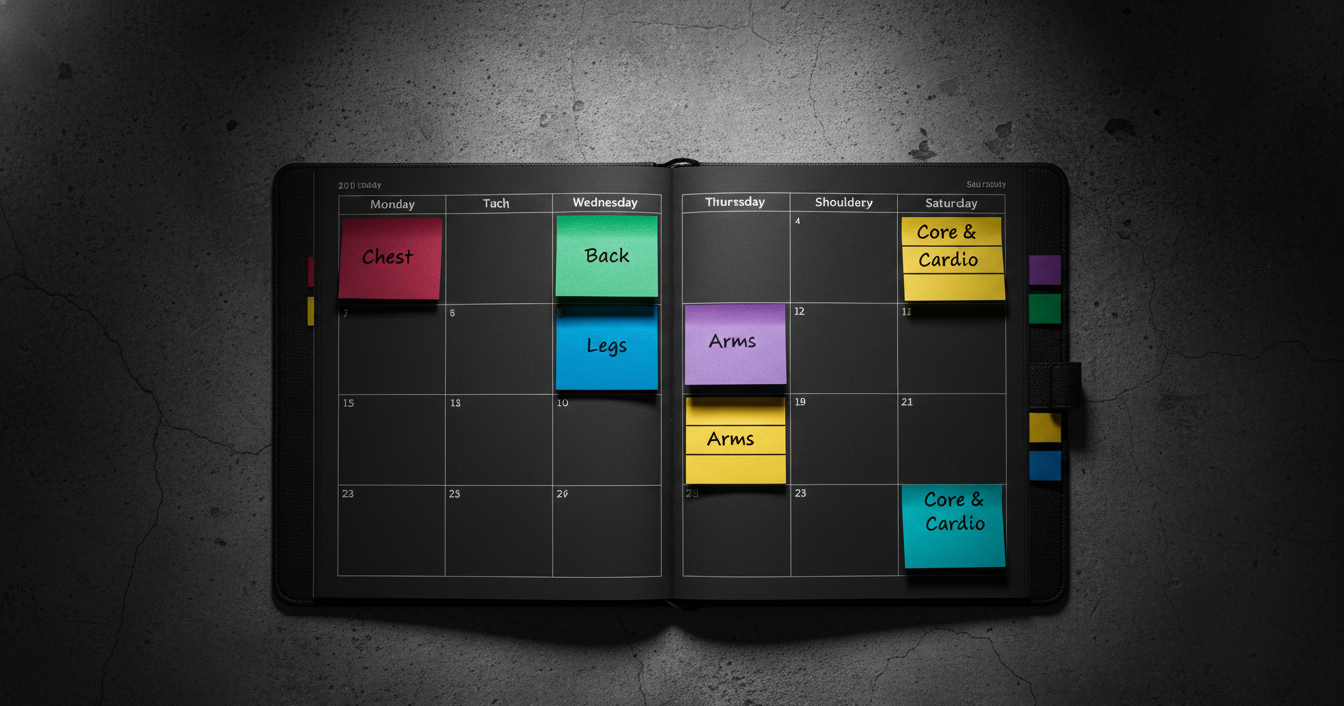
Structure: Chest Monday, Back Tuesday, Legs Wednesday, Shoulders Thursday, Arms Friday
Frequency per muscle: Once per week
Best for: Bodybuilders with specialised muscle group focus; less relevant for general cutting
During a cut: The once-per-week frequency is below optimal for muscle retention. Missing any session means that muscle group is trained just once every 2 weeks.
Verdict: Not recommended as a primary split during a cut for most people.
Warning
The "best" split is the one you'll follow consistently. If you love your bro split and have been running it for years, completely overhauling your training at the start of a cut adds an unnecessary variable. Modestly adjusting your existing split is often better than adopting a new one.
Recommendation for Cutting
- 3 days/week: Full body
- 4 days/week: Upper/lower
- 5 days/week: Upper/lower with a third upper or lower, or modified PPL (2 upper, 3 lower or vice versa)
Myprotein Impact Whey
The UK's best-selling protein powder. 21g protein per scoop, under 50p per serving on sale.
Affiliate link. See our disclosure.
Key Takeaways
- Train each muscle group at least twice per week for optimal muscle retention during a cut
- Full body (3 days) and upper/lower (4 days) are the best-suited splits for cutting phases
- 6-day PPL is typically too demanding during a significant deficit
- Bro splits (once per week per muscle) have suboptimal frequency for muscle retention
- Consistency with your chosen split matters more than marginal differences between evidence-based options
- If changing your split for a cut, keep the change minimal — don't overhaul everything simultaneously
More like this