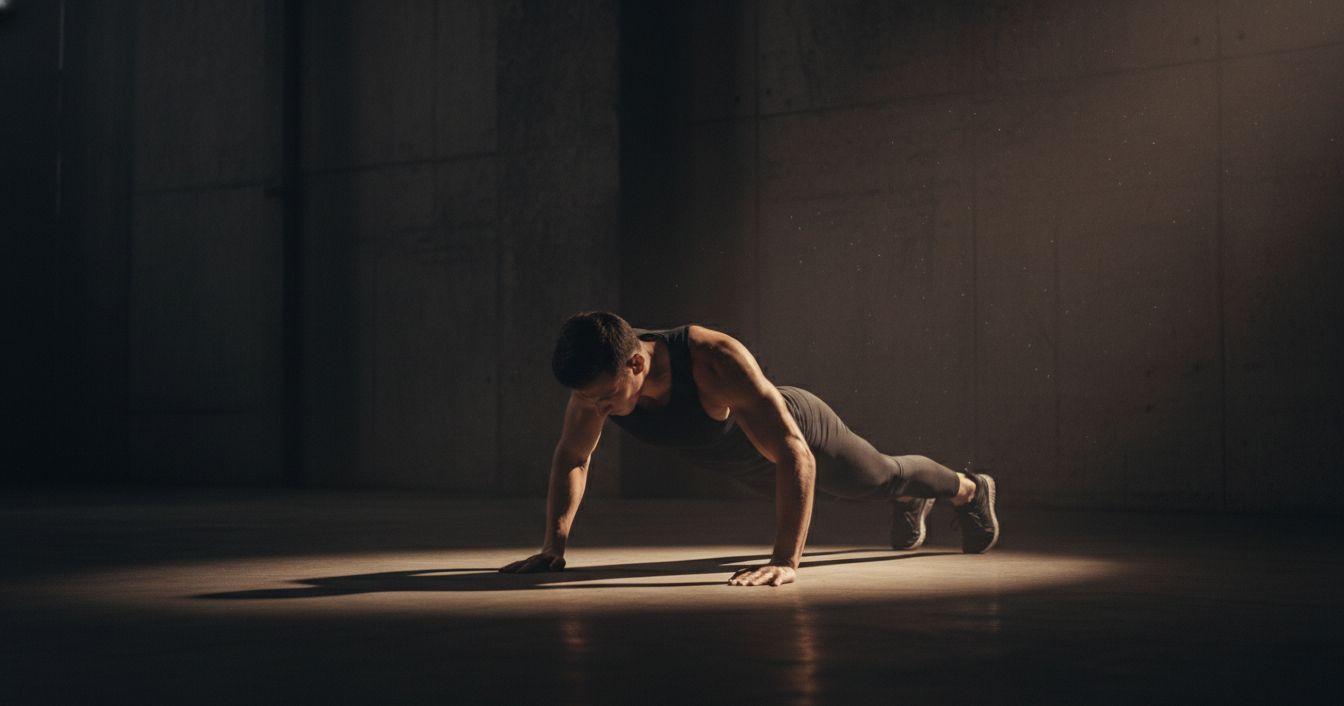
bodyweight program
3-Day Tabata Protocol
Overview
Tabata training originated from the research of Dr Izumi Tabata at the National Institute of Fitness and Sports in Japan. The protocol — 8 rounds of 20 seconds maximum effort followed by 10 seconds rest (4 minutes per exercise) — has been shown to improve both aerobic and anaerobic capacity simultaneously. Applied to bodyweight exercises, it becomes an extremely efficient fat-loss and conditioning tool.
Three sessions per week with rest days between each provides adequate recovery while maintaining the training stimulus. Each session targets different movement patterns to prevent overuse fatigue.
Schedule
| Day | Session |
|---|---|
| Monday | Session A — Lower Body Tabata |
| Wednesday | Session B — Upper Body Tabata |
| Friday | Session C — Full Body Tabata |
| Tuesday / Thursday / Saturday / Sunday | Rest |
Warm-Up Protocol
Tabata demands maximum effort from round 1 — you must be genuinely warm before starting. 5–8 minutes of progressively faster cardio (walk → jog → near-run on the spot), then 2 minutes of dynamic stretching. Do not skip this for Tabata.
Format
Each exercise block: 8 rounds of 20 seconds maximum effort / 10 seconds rest = 4 minutes. Rest 60–90 seconds between exercises.
Week 1–4: Foundation Phase
Day 1: Lower Body Tabata
| Exercise | Rounds | Work | Rest |
|---|---|---|---|
| Jump Squats | 8 | 20s | 10s |
| Rest | — | — | 90s |
| Alternating Jump Lunges | 8 | 20s | 10s |
| Rest | — | — | 90s |
| Glute Bridge Pulses | 8 | 20s | 10s |
| Rest | — | — | 90s |
| Mountain Climbers | 8 | 20s | 10s |
Total working time: ~20 minutes. Burn: 200–350 calories.
Day 2: Upper Body Tabata
| Exercise | Rounds | Work | Rest |
|---|---|---|---|
| Push-Ups | 8 | 20s | 10s |
| Rest | — | — | 90s |
| Tricep Dips (chair) | 8 | 20s | 10s |
| Rest | — | — | 90s |
| Pike Push-Ups | 8 | 20s | 10s |
| Rest | — | — | 90s |
| Inverted Rows | 8 | 20s | 10s |
Day 3: Full Body Tabata
| Exercise | Rounds | Work | Rest |
|---|---|---|---|
| Burpees | 8 | 20s | 10s |
| Rest | — | — | 90s |
| Squat Thrusts | 8 | 20s | 10s |
| Rest | — | — | 90s |
| Push-Up to Hip Raise | 8 | 20s | 10s |
| Rest | — | — | 90s |
| High Knees | 8 | 20s | 10s |
Week 5–8: Intensification Phase
Add a fifth exercise block per session. Reduce inter-exercise rest from 90 seconds to 60 seconds. In weeks 7–8, increase to 10 rounds per exercise instead of 8 (5 minutes per block).
Additional Exercises to Add (Weeks 5–8):
- Day 1: Broad Jumps
- Day 2: Pull-Ups (max reps per 20s)
- Day 3: Tuck Jumps
Progression
Tabata progress is measured by reps completed per 20-second window. Track your best round count for each exercise and aim to increase over weeks. If you complete fewer reps in rounds 7–8 than in rounds 1–2, that's expected — maximum effort means you're working at your limit.
Adjustable Dumbbells
One pair replaces an entire rack. Essential for home training.
Affiliate link. See our disclosure.
Cutting Modifications
Tabata is highly compatible with cutting — the metabolic stress from 20-second maximal efforts creates significant post-workout calorie burn (EPOC). On a cut, avoid adding extra Tabata sessions beyond three per week — recovery suffers significantly. Ensure you consume protein within 60 minutes after each session to limit muscle protein breakdown. If energy is severely impacted by the deficit, reduce to 6 rounds per exercise block rather than 8, maintaining maximum intensity per round.
Pro Tip
Every round of Tabata should feel like it's at your limit. If you're finishing rounds 7 and 8 feeling comfortable, you're not working hard enough in rounds 1–4. Push harder in early rounds and let the difficulty scale itself.